
Over the years, the many carriage, cycle and car races, rallies and foot races, both relay and individual, must make the London to Brighton Road one of the most famous and busiest in the world.
These races started in the 18th century, even before it was properly tarmacked. I do not know of any claim to it being a Roman road, particularly as Brighthelmstone did not come into existence until the 18th century. None of the many excellent books on Brighton seem to agree when it became a town. We know that there were three Roman camps between the coast and Ditchling, including Hollingbury, which is really of Iron Age construction and dating back to 250 BC.
In 1783, George, the eldest son of George III and later Prince Regent, first visited the town; it was already established as a place to stay, with a road for carriages. It was from then that the challenges to ride or walk or run from London to Brighton started.
I did not envisage when I decided to record Sussex athletes' efforts on the London to Brighton Road that it would involve me ploughing through my books on Brighton to discover where to start. I eventually decided on 1919 when the Surrey Walking Club held their first Open Race under A.A.A. laws. There had been earlier races, some by the Stock Exchange, but these had not met the A.A.A. laws.
The early races saw around 20 to 25 walkers complete the then 52-mile course. Still, the actual distance varied upwards several times before the annual race was over 55 miles plus a few yards in 1984. The weather conditions did have a significant, almost always detrimental effect on times.
It was 1927 before I can find a Sussex name in the finishers, and that was H.V., (Vic) Lloyd of the Sussex Walking & Athletic Club, who finished 18th. In 1930 H.W. (Harry) Tyler, also of the SW&AC place 48th, was to become the administrative backbone of Sussex Walking until he was in his seventies in the late 1980s, while in 1931, SW&AC became the first Sussex club to complete a team in this event.
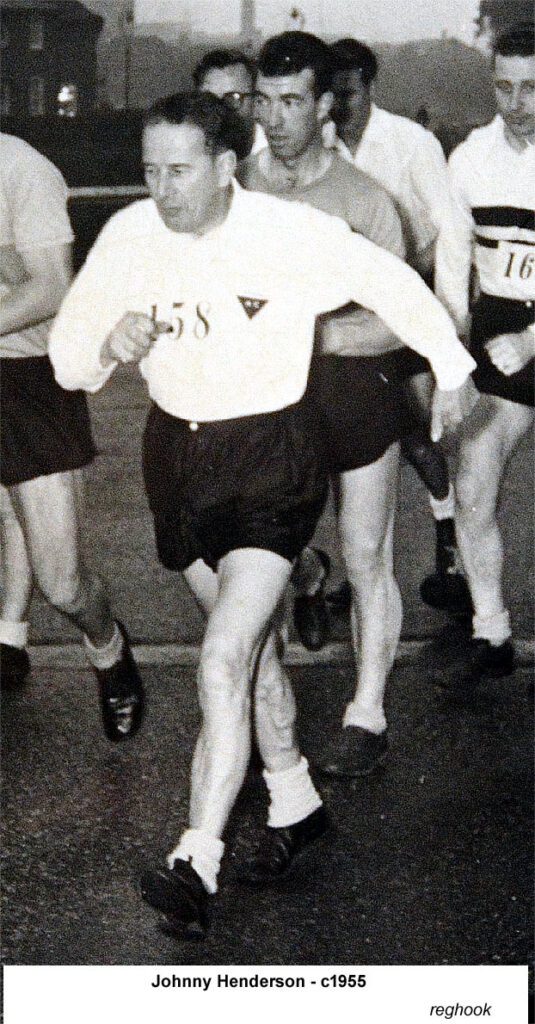
In 1934 Johnny Henderson from Steyning, though then a member of the Worthing & District Harriers, came on to the Race Walking scene, and he remained one of the top Sussex and for many years British Walkers for many years. He finished seventh in 8:49:57s, and the following year he moved up to third place in 8:12:23s behind winner Harold Whitlock (Metropolitans Walking Club), who was to go on to be the only British individual gold medallist at the Berlin Olympic Games in the 50km walk. Harold was later to retire to Eastbourne and was a regular Coach and race walking judge in Sussex.
There was a gap of eleven years then till 1946 when Sussex walkers did not appear to compete and of course a break for the War years, which would account for six of those years, However Johnny, who was now wearing the SW&AC colours, returned from his Military service in fine form and recorded his highest placing in the second position just beating Whitlock into third place but this time it was Harold's younger brother Rex who was to win the title several times.
1947 saw another fine walk from Henderson, who finished 5th while Brighton & County's Cyril Wingate spent his spare time when he was not working or racing as a highly popular Zylo the clown at Children's parties, finished 11th, and SW&AC placed fifth in the team event.
Henderson was still pressing the leaders in 1948 when he just missed getting a place in the British Olympic 50km squad at the Wembley Olympics. He missed another medal, placing fourth, and Wingate also moved up to finish seventh, but SW&AC dropped to sixth in the team event. Wingate was to join the "Centurion Club" when he finished third in the London to Brighton and back race.
It was Wingate who led the Sussex walkers home in 1949, placing 13th while Henderson placed 18th and led the SW&AC team into ninth spot.
Henderson, who was now 43 years old, was back to his earlier form with a fourth place in 1950, but no Sussex walker made the top twenty placings again until Brighton Athletic Club's Frank Turner placed 16th in 1955 in 8:58:30 and this was a bleak time for Sussex long-distance race walking.
The merger of the Brighton & County Harriers and Sussex Walking & Athletic Club in 1951 also saw a group of walkers from the Steyning area, led by Henderson and including National Junior champion Norman Read, form the Steyning Athletic Club. It was a battle to develop a real team. This meant that Sussex's walking talent was split between the new Steyning Club and the merged Brighton Athletic Club.
It was not until 1962 that 56-year-old Henderson tackled the race again and placed 32nd in 9:44:40, six places behind his Steyning club mate Tom Tidy that Sussex was again represented.
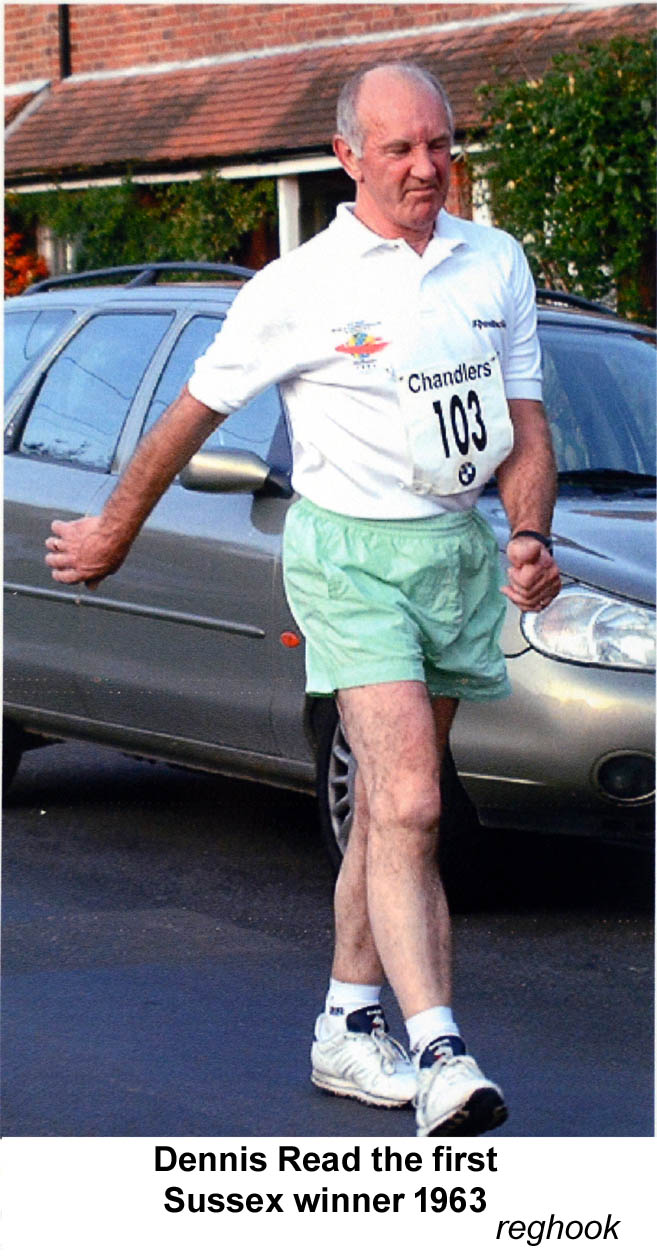 Dennis Read (Steyning), the younger brother of 1956 50km Olympic champion, had a wonderful walk to become the first Sussex winner of the "Blue Riband" of British Distance Walking in 8:06:58, in 1963 the fastest time by a debut winner and at just 22 was the youngest ever winner of the title and probably remains so today. Johnny Henderson, who coached Dennis and indeed Norman in his younger days, was again on the road and finished 33rd.
Tom Tidy was the leading Sussex walker in 1964 in 25th place, but Dennis Read was back challenging again in 1965, placing sixth but not as fast as his winning time two years earlier. However, he led the Steyning team into the third team spot with C.D.Wilkinson placing 12th, Dave Boxall (Brighton) 13th, Tom Tidy in 40th position and Henderson closing in the team in 55th place.
Come 1966, big brother Norman was racing with high hopes of another victory and possible even the team title, but it was not to be. Norman was in contention until the closing stages when Surrey's Ken Mason broke away as Norman was going through a bad patch, but he hung on to second place in 8:36.08. Brother Dennis finished in seventh place, Ron Penfold was 14th, and Pat Cassie 15th and the team placed second while Henderson was still competing, at the age of sixty and placed 32nd. It was not until 1969 that Sussex got another Top 20 placing when Brighton & Hove's Dave Boxall finished in seventh place with club mates Brian Saunders 17th and Byron Williams 19th while one year later Boxall was 11th, Alan Buchanan 21st and Saunders 22nd and the Brighton & Hove team finished third.
 They repeated their third team placing in 1971 with Boxall having his best finish to take the bronze medal in 8:48:36 and Saunders filled 20th position and they completed a hat trick of third-team placings in 1972 Boxall again showing them the way home in fourth place and club mate John Lees having an excellent debut in tenth place and James Hoare18th.
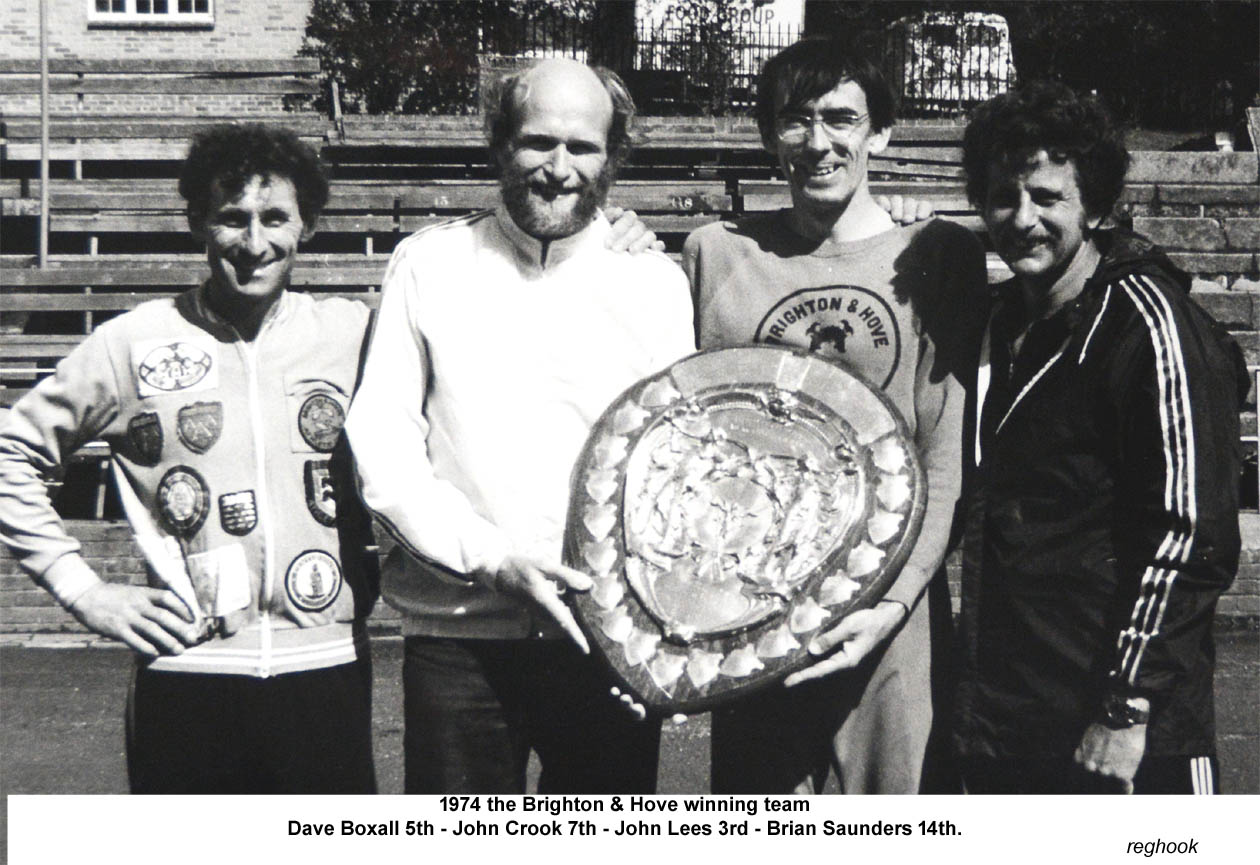
In 1973 Boxall again led the Sussex walkers in sixth places and Saunders 21st, but 1974 was the triumphant year for the Brighton & Hove walkers as they became the only Sussex Club to win the team title. In an epic battle, they scored 26 points, the same as the oft time winners Belgrave but as Brian Saunders closed in the Brighton & Hove scoring four in 14th place, ahead of the fourth Belgrave walker, Brighton took the title. Lees had placed third, Boxall fifth and John Crook seventh to complete the team.
Boxall picked up his second bronze medal and his fastest time of 8:19:01 in 1975 with Dennis Read back on the scene in 11th place and club mate Tony Geal placing 18th.
Johnny Henderson finished 65th, which nearly matched his 68 years of age. I believe this was his tenth and final appearance in the "Brighton", almost forty years after he had won the London to Brighton and back race to become the first official Sussex Centurion.
Peter Hodkinson, who was born in Eastbourne but joined Cambridge Harriers when he was in the Metropolitan Police, became the second Sussex individual winner in 8:06:13 in 1976. Boxall was again in single figures in 6th place.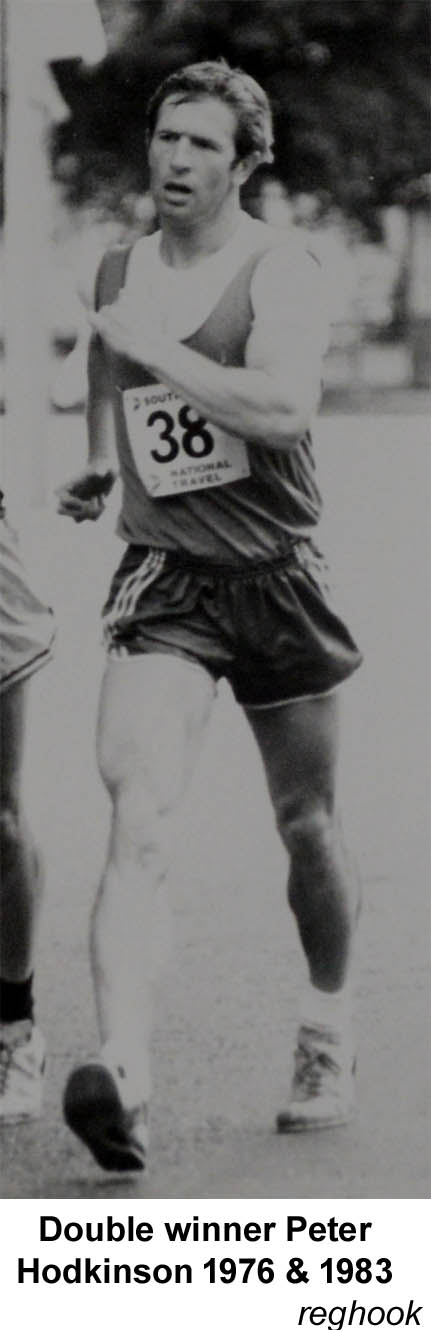
There was another winner in 1977 when Brighton & Hove's John Lees stormed to a fourteen-minute victory in the fast time of 7:54:32. He moved into the lead from the start and was on his own after 15-miles. He joined a select club of walkers who completed the race inside eight hours. It must be remembered that John had already tucked the world record for walking across the U.S.A. under his belt. Boxall was 12th, and there was another third team placing for the Brighton & Hove Club.
In 1978 Boxall chalked another fourth placing while Lees finished 10th, having earlier won the Manchester to Blackpool race and I believe he is the only walker to do the double.
In 1979 Ian Richards (Coventry) pulled through in the closing stages to win the race, and many years later, when he retired, he moved to Sussex and joined Steyning Athletic Club. He took on the Sussex mantle and is currently the leading Sussex distance walker, while Dave Boxall collected his third bronze medal.
 Steyning's Dave Ringshaw led the Sussex challenge in 1980, placing 15th, and Brighton & Hove's Mike Turner came 20th, but there was no Top Twenty finish in 1981, which was the year that really spelt the end for the race. An accident at Pycombe caused the death of a walker. This year Peter Selby (Surrey WC) won the title, and he is another walker who has since moved into Sussex and is doing sterling work with race Walking groups at Lewes but is not a Sussex qualified athlete.
There were no Sussex competitors in 1982. Peter Hodkinson repeated his victory of 1976 in 1983, taking the lead within the first mile and never losing it after that to become the only Sussex walker to win twice. Dave Boxall recorded his eighth Top Ten finish in 8th place and remained the only Sussex athlete to complete both the Walk and the Run on the London Road.
With only 18 walkers completing the course in 1984, it was decided to pull the plug on a race that was getting increasingly unsafe though the Stock Exchange continued to hold their race for several years and opened their event to all athletes. Steyning's Dave Stevens, who we lost in January was a member of the Stock Exchange, won that event in 1975.
It was undoubtedly an addictive race with Johnny Henderson making the journey ten times between 1934 and 1975 and both Tom Tidy and Dave Boxall13 times between 1956 and 1977 and 1965 and 1983 respectively, including three bronze medals for Dave
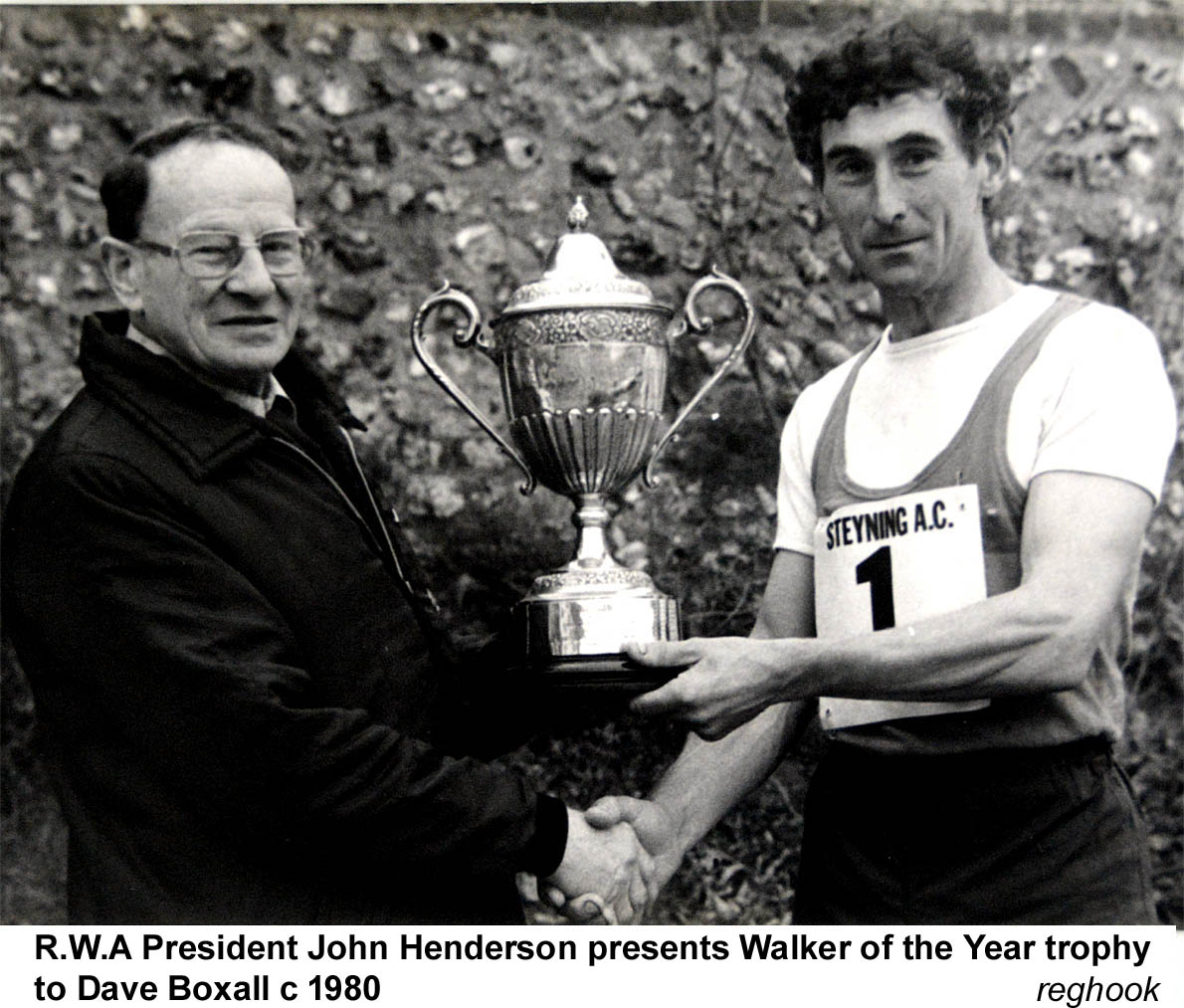 The races were merged with the Stock Exchange race and became an Open event in 1999. In that year Jean Bleach from Steyning was the second woman finisher in 10:36:08, while club mate Liz Claridge was fourth in 11:12:44 and with her father, Martin Ford-Dunn, 11:14:17 became the first Father and Daughter to complete the London to Brighton though way back in 1972 Brighton & Hove's Brian Saunders finished 23rd and son David finished 42nd.
The final race was held in 2003, but then the race finished at Braypool recreation ground on the edge of the City and Roger Osgood, who belonged to the Havant club, as the last Sussex walker to complete the race.