

There is little dispute that the greatest Sussex athlete of “all time” is Steven Michael James Ovett - born in Brighton on 9th of October 1955 to Market Traders, Mick and Gay.
Right from his first appearance at the Withdean Track he was a very competitive character, and his talent was revealed once he joined the Brighton & Hove Athletic Club and displayed a huge range of athletic abilities.
 In the 1920s and also a member of the Brighton Club, Ernie Henley, won every Sussex title from 100 yards to One-mile. Steve might have been hard pressed to match that as Sussex had some top notch sprinters in the mid/late seventies. However, Ovett did have a pretty impressive cross-country record as well.
Right from the start of his athletic career he had the style of a gazelle in flight but also with a little more muscle.
Probably his first step on his fifteen year career was when he tackled the junior 400 and 800 metres at the Brighton, Hove and Portslade Schools’ Championships and finished streets ahead of his rivals in championship record times in 1970. The Sussex Schools’ title followed and then the English Schools junior (U15) 400 metres crown in 51.6.
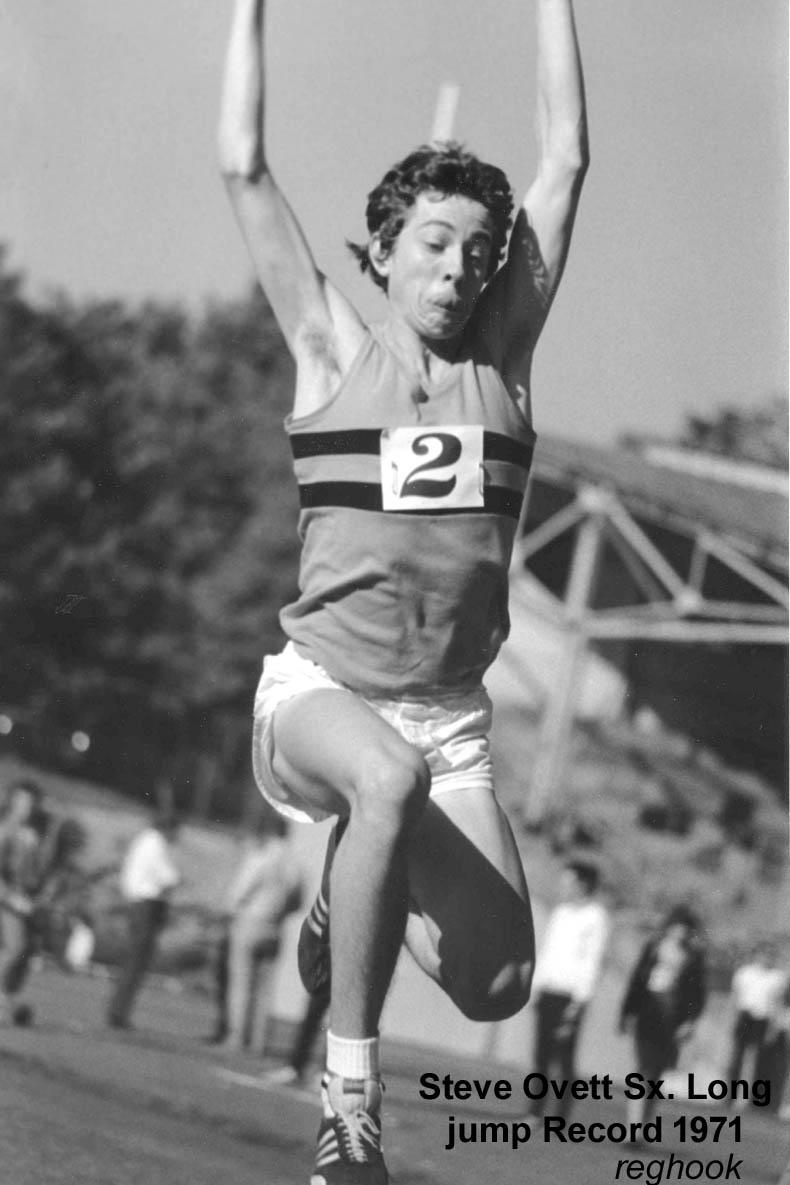
Right from an early age, records came easily, but he never put himself out to collect them. In 1971 Ovett tried his hand at something different and notched up a Sussex U15 boy’s long jump record of 6.25m - which stood until 1989.
In his autobiography, with John Rodda in 1984, Steve lists six pages of races. I will not duplicate these but will mention some of his major events.
He liked running and racing against people. To me his World Record breaking attempts in the late seventies and early eighties were really out of character. Racing was his forte and when you look at today’s athletes and the number of races they do, they pale alongside Steve who would sometimes churn out nearly thirty races a year including Cross-country and road running events.
Ovett rarely missed the Southern or AAA Championships and in the few years up to his triumphant run at Moscow, he was a frequent member of the Brighton & Hove team in their British League matches, sometimes even filling in with a “B” 200m victory.
In 1972 there was a second place in the English Schools Inter Cross Country championship behind Kirk Dumpleton (Seb Coe finished tenth), more County and Sussex Schools’ titles and a runaway victory in the English Schools Inter 800m, at Washington by a street. The championship record had been held by Peter Standen from Sussex in 1958, and who is still a Sussex coach, and although Steve was well capable of smashing the time he only wanted to win and was not concerned with the record.  The AAA Youths 400m title followed shortly and then an invitation 400m youth race saw him set a UK youth record with 48.4s.
Another second place in the English Schools’ Senior Cross-country Championship at Swindon in 1973, this time behind Kevin Steere and later in the year a gold medal in the European Junior 800 metres at Duisburg in 1:47.5s. 1974 saw an AAA’s senior title in 1:46.9s and second place in the Euro champs in Rome in 1:46.77s.
1975 saw him become the first ever Sussex runner to win the National Junior Cross-Country title at Luton. Following this was another AAAs title over 800m in 1:46.1s, while 1976 opened with victory in the South of Thames Cross-country Championships in Stanmer Park and victory in the Inter-counties 800m at Crystal Palace in 1:47.3s. and a double victory in the UK Olympic Trials.
At the Olympic Games in Montreal Steve finished fifth in the 800m final having had the misfortune to be drawn in the outside lane on the only time that the first three hundred metres were run in lanes. Still an unexperienced youngster, he came in to the bell miles off the pace and did well to claw back as much as he did in 1:54.4. He did not reach the final of the 1500m.
A second place behind David Black in the Inter-counties at Leicester followed by 13th in the National at Parliament Hill, which was won by Brendan Foster made a steady start to 1977 but fine victories in both the Europa and World cup 1500m event later in the year put down the marker that he is also to be feared over the longer distance.
1978 started with the third of four Sussex Senior cross-country titles which caused a protest as the age rules had been changed and Steve, under ECCU rules despite already winning two senior victories, was still a junior. However, the race was advertised as under AAA rules where he was still a senior. Southern Counties ruled that he was eligible and a couple of weeks later be became only the second ever Sussex runner to win the Inter-County Cross country title at Derby. The rest of the year followed a similar pattern until the European Championships at Prague, when he was squeezed into second place in the 800m behind Olaf Beyer but still recorded a British record of 1:44.1s behind the winner and ahead of third place Seb Coe. Three days later he won the 1500m crown in 3:35.6s and later won the “Oslo Mile” in a UK record of 3:52.8s.
A comparatively easy 1979 but still nearly thirty races including a couple of cross-country events and several British League races plus a win at the Ivo Van Damme Memorial 1500m and both the “Emsley Carr”, then a very important high class race and the IAC/Coca Cola miles at the end of the season.
 1980 must be considered the most important year of his career and he warmed up for his Olympic 800m gold medal with a World Record for the one-mile of 3:48.8s at the Bislett Stadium in early July and just two weeks before his triumph in Moscow he equalled the 1500m World Record, again at Bislett, in 3:3:32.09s.
After winning the Olympic 800m title comfortably in 1:45.4s many were convinced that he would become the first British winner of both 800m and 1500m Gold medals since Albert Hill in 1920. Hill was a member of the Brighton Railway Athletics Club but I do not know whether this membership was before or after of his victories.
We were not aware of Steve’s family pressures and he was not the same Ovett we saw in the 800m. He finished third and in his autobiography he said: “I ran the best race I could but was beaten by two better guys”.
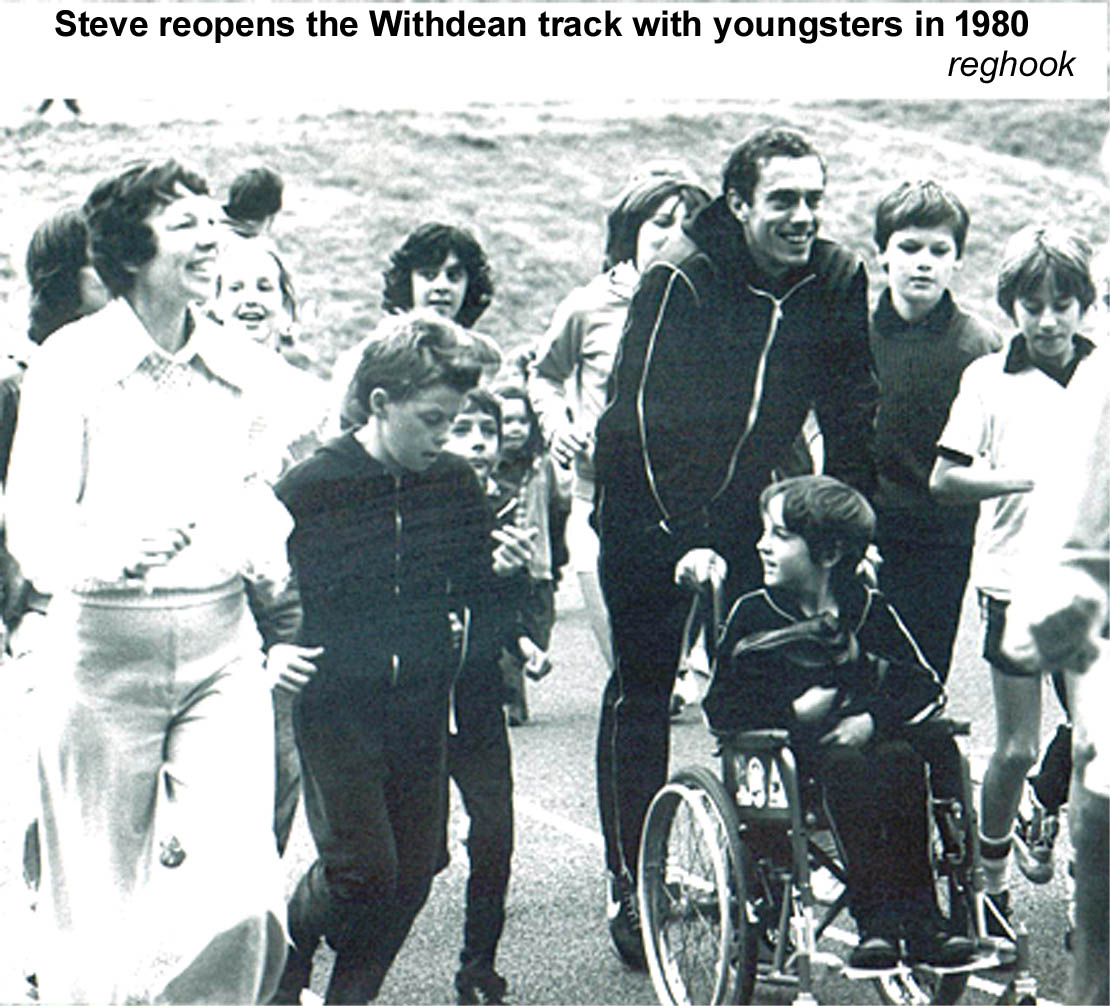
There were a few more races but he still found time to run laps and officially open the newly furbished Withdean Stadium with an all-weather surface. Although tired Steve was in his element as he took several thousand of runners, mainly youngsters, for a lap of the Withdean track fifty at a time.
Ironically Steve never raced on the new Withdean surface though he did act as pacemaker for Phoenix club mate Mark Rowland when he needed a fast time.
Early in 1981 Steve agreed to join with training companion Matt Paterson to form Phoenix Athletic Club for top runners.
Steve lists thirty races for 1981 and regards this as the most rewarding of years just two second places blemish an unbeaten year and a world breaking 3:48.40 clocking of Koblenzy highlight the twelve months but no major games meant Steve could do what he liked best, running and winning. It did however came to a rude ending as, when training with Sam Lambourne in Hove he crashed into a low rail and put himself out of action for several months including a major operation so it was a late start to 1982 before he was back in competition. Whatever his fears must have been he was running well but avoiding the pressure of fast 800 metres races in a rather quiet year.
1983  was also a tentative year and he was squeezed out of the medals in the 1500m at the World Championships at Helsinki but managed to chalk up another World Record over 1500m at Rieti in 3:30.77 in September.
It was, in retrospect, a tentative run up to the Los Angeles in 1984, but once he finished fourth in the semi-final of the 800m the writing was on the wall. He finished eighth in the final and collapsed over the line to be stretchered off. Ovett never finished eighth and last, in championships races. Although he was to win his heat of the 1500m he finished fourth in his semi-final and did not finish in the final being taken off the track in a chair with seemingly breathing problems but according to Steve was nowhere near as dramatic as viewers saw or the media depicted.
In his mind there was never any suggestion to Steve that this was the end although his autobiography comes to end with his return to England.
His problems were later diagnosed as bronchitis and he took his time recovering in 1985 but cut out 800m races and added some longer distance races and it was much the same in 1986 as he prepared for the Commonwealth and European Games.
At Edinburgh he was completely in command winning the 5000m title in 13:24.11s with Crawley’s Tim Hutchings taking the bronze medal. Come the European Championships, however, he failed to complete the final of the 5000m.
Steve was to continue to run, as he had always done, and race, even after his move to Scotland in 1989, when the accent was more on the longer races, right up to his retirement in 1991, which was the last year that he featured in the British Ranking Lists.
Steve’s fastest times were: 400m. 47.5s 1974 – 800m. 1:44.09s 1978 – 1500m. 3:30.77 1983 – One mile. 3:48.40s. 1981 - 3000m. 7:39.7s 1978 - 5000m. 13:20.6s. 1986 - Half Marathon 65:38 1977.
 Following his moved to Australia he did some television commentating including for the BBC at the Melbourne Olympics.
Steve is certainly the greatest Sussex athlete to date and some have claimed him to be the most versatile British athlete ever. He was certainly the most talented while Coe may have just had the edge on World Records and Olympic medals it was Ovett who covered the widest range of events and his cross-country record was certainly better than Coe’s.
The only British athlete to stand comparison would surely be Sydney Wooderson who’s range from 400 metres to National Cross-country champion was as remarkable and who knows what he would have done had not injury ruled him out of Berlin Olympics and was deprived of the Tokyo Games of 1944 while selectors told him that if he ran the 1947/8 cross-country season he would not be considered for the 1948 Games although he had already won the European 5000 metres championship in 1946?
Neither Coe or Wooderson however was a twenty foot (6.09m) long jumper at 15.
Despite his apparent arrogance I think Steve Ovett was basically shy and who just loved to run and of course to win and was much more relaxed in the company of youngsters than adults.