
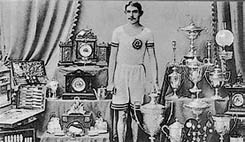
ALF SHRUBB – by Keith May
Alf Shrubb was born in Slinfold, Horsham on 12th December 1879. His introduction to running came in 1898 when after arriving home from work as a bricklayer he was aware that a fire was taking place at Southwater, some three miles away. A neighbour, Fred Spencer, who was captain of the Blue Star Harriers, suggested to Shrubb that they try and beat the horse drawn fire engine to the scene of the fire. Shrubb agreed and the two ran down the roads and across the fields to the scene of the fire, a haystack. Spencer noticed how comfortably Shrubb had run with him and suggested that he joined the Club.
Shrubb’s career progressed fairly rapidly, having started by winning local Club events, beating the then club champion Fred Spencer, and then winning the Sussex 4 mile championships at Bexhill. It was after this race at Bexhill that Shrubb came to the attention of Thomas Sinnott, who was one of the leading figures of the bigger and more prestigious Club, South London Harriers. Sinnott realised that Shrubb could strengthen his club and persuaded Shrubb to join SLH, which he did at the end of 1900, but retained his second claim status of the Blue Stars, and continued to compete in many of the Club’s local races. At SLH he was taken under the wing of Harry Andrews, one of the top coaches of the time.
 He became adept at most distances from 1 mile up to 10 Miles, although Cross-Country was his favourite form of the sport which saw him winning the National Cross Country titles in 1901, 1902, 1903 & 1904 as well as taking the Southern Cross Country titles in the same years. Winning both the Southern and National titles in 1901 at his first ever attempt. He won the International Cross Country Championships (now the World Championships) in 1903 & 1904 and he won several AAAs track titles at 1 Mile, 4 Miles and 10 Miles. Shrubb unfortunately never had the opportunity to run at an Olympic Games. The 1900 Games in Paris came too early in his career, and Britain did not send a team to the 1904 games held in St.Louis, as it was felt it was too far to travel. Shrubb was not too disappointed as the longest flat race on the track was 1500m and he had too many commitments in Britain to spare time for a lengthy trip across the Atlantic.
Perhaps Shrubbs’s greatest achievement was performed at Ibrox Park, Glasgow where on 5th November 1904 he put up one of the greatest endurance runs ever. His aim was for the British 10 mile record, but his pace around the cinder track on a cold damp night was so relentless that, cheered on by a massive crowd, he ran an incredible 50m50.6s for the 10 miles to set not only a British record but also a World record. He then continued on to set a new World & British record for the 1 hour, running a distance of 11miles 1,137yards. To put in perspective the outstanding nature of this run is that the 10 mile performance stood as a World record for 24 years and a British record for 31 years.
In 1905 Shrubb was invited to compete in Australia and New Zealand, which with the approval of the AAAs, he gladly accepted. Giving him the opportunity to see part of the world. During the 6 month voyage by ship he continued his training regime, by running several laps of the deck in the morning and then walking in the evening. Whilst away he ran several races, against the local champions, winning most of them and enhancing his reputation. On his return in 1906, however, he was permanently suspended from athletics, seemingly from allegations of receiving excessive travel expenses for appearances at certain provincial meetings. Rightly or otherwise he was finished as an amateur. Shrubb continued to compete professionally, including running races and exhibitions against relay of runners and even racing against a horse over 10 miles, where the horse beat him by 15 yards. In 1908 he moved to Toronto, Canada where he continued to race many of the leading distance runners and then took to coaching at Harvard University in America, based in Boston, but a long way from his Toronto home. He returned to his beloved homeland in 1920 when he was appointed the first professional coach to Oxford University AC. During this time he returned to meet up with the Blue Stars where he presented a trophy for the Club to use. Despite several years of success at Oxford, his contract was not renewed at the end of the 1927 season. In 1928 he moved back to Canada where he became a farmer. He made a trip to the UK in 1952, where he again met up with the Blue Stars of that time. The AAAs also honoured him by reinstating him as an amateur. Shrubb died in Bowmanville, Ontario on 23rd April 1964, aged 85. According to those who knew him, Shrubb was a modest, quiet unassuming man, well aware of his ability, but also always aware that his records could and would be eclipsed. Without doubt Alf Shrubb was one of the greatest distance runners that the UK has ever seen.
References: “Little Wonder” by Rob Hadgraft, Kings of Distance by Peter Lovesey and Running and Cross country Running by Alfred Shrubb