
Over the next couple of weeks I hope to tidy up the list of Sussex Olympians with brief details of those who I have not managed to include in our profiles over the past few months.
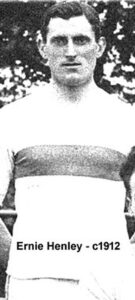
1912 Stockholm: Ernest (Ernie) J Henley was the second Sussex Olympian behind his Brighton & County Harriers clubmate George Larner, who we have featured as the only Sussex double gold medallist 1908 in 1912. Henley (31-3-89 – 14-3-62) was a talented and the best middle distance runner but also a pretty nippy sprinter. At Stockholm he reached the semi-finals of both the 400 metres and the 800 metres, where he clocked 1:57.6s but was also a member of the 4 x 400m Great Britain relay team that won the bronze medal in 3:23.2s
Continued to race right through to the 1920s and actually won every Sussex title from 100yds to One mile but not on one afternoon. Henley stayed with the sport and I believe was, for a time the County treasurer and was the chief announcer at County Championships and most major meetings in Brighton until they moved to Hove in 1949.
He was also the Chairman of the Brighton Ladies Athletic Club.
He worked in the Accountants department of Hanningtons the high class local Department Store, which is still much missed by many older people from Brighton and the surroundings.
His daughter Joyce was also an athlete and for several years in the 1940s/50s was Secretary of the Sussex County Women’s Athletic Association as well as Treasurer.
= = = = = = 1924 Paris: = = = = = =
Guy Montage Butler was born at Harrow on 25-08-99 and died on 22-04-1981 and was a part time Sussex athlete. He already had an Olympic Gold and silver medal from the 1920 Antwerp Games when he took up the post of a School master at Lancing College after coming down from Cambridge University where he had been awarded Blues for Athletics and Cricket. He competed in Sussex championships and set the Championship record for the 220 yards at 22.4s in 1927, a record that survived at least thirty years.
In 1920 at Antwerp Butler’s medals came as a member of the Great Britain 4 x 400 metres, where he anchored the team to Gold after he had won the silver medal in the 200 metres. In 1924 in Paris he took the bronze medal in both the 400metres and another bronze in the 4 x 400m relay and he became the first British athlete to win a Gold, Silver and Bronze Olympic medal an achievement that was not repeated until Mary Rand did it in Tokyo in 1964 and indeed became the first to win four Olympic medals. Only Seb Coe and Mo Farah have matched that performance.
Butler reached the semi-finals of the 200 metres at Amsterdam in 1928 and he retired soon after the “28” Games.
That was by no means an end of athletics for Guy Butler, he became a journalist with the Morning Post until its merger with the Daily Telegraph in 1937 and helped to design the White City Stadium. He also came an athletics Coach but attracted World fame as the pioneer of slow motion coaching loop films that were to become a “Must” at all Major and many minor Coaching Courses throughout the World and special Analysing projectors were used to show the continuous loop films.
= = = = = = 1928 Amsterdam = = = = = =
Arthur J Muggeridge was born in December 1904 and died at the tragically young age of 28 on 25th July 1933 in Brighton and ran for the Brighton & County Harriers during his formative years.
He was a talented Road and Cross-country runner becoming the first runner to win the Sussex Senior Cross-country title three times in 1926, 1927 and 1928.
I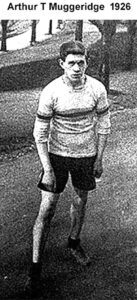 n 1927 Muggeridge, now with Polytechnic Harriers, was selected to run for England against France in a match that was held at Brighton’s Preston Park. In the three-mile race he was an unexpected winner ahead of the much fancied French runner. The French, so the legend goes, were stunned and invited him to race again over 5000m in Paris and the Brighton runner repeated the medicine. The following year he ran in the 10,000m in Amsterdam where he finished an excellent fifth in 31:31.8s.
= = = = = = 1948 = = = = = =
At the celebration of the 14th Olympiad at Wembley Stadium in London in 1948 we saw two Sussex athletes selected for the Great Britain team. T.P.E (Tony) Curry (Thames Hare and Hounds/Achilles) and Michael Pope (London A.C). How I miss the wise advice of the late former County Chairman, Dickie Webb who was a fount of knowledge about leading Sussex athletes. I have little knowledge of their pre selection performances.
Pope born on 25th February 1927 and died on16th May 2016 in Devon competed in the 400m hurdles, an event that was not a regular event in many athletic meetings at the time and did not appear in Sussex championships until the early 50s. He clocked 55.3s for fourth place in his heat but did not progress to the later stages. One year later in 1949 Pope won the Sussex County 120 yards hurdles in 16.6s at the Greyhound Stadium in Hove.
I believe he served in the Army.
T.P.E. (Tony) Curry was an Oxford University athlete and competed in the 3000m steeplechase at Wembley. Tony finished seventh in his heat and did not make further progress
Like Pope he competed in the Sussex Championships at Hove in 1949 but was surprisingly beaten into second place in the 5,000m by Worthing’s Peter West with Hugh Foord (Brighton) in third place.
Curry retired shortly after this run to concentrate on his career in the Law, he became a Q.C. and he represented the Beatles, John, George and Ringo against Paul McCartney over the Apple Records take over in 1975.
I would be very pleased to receive any corrections or information about the above on reghook@ntlworld.com.