
If someone set a series of World Athletics Records and then topped this with two Olympic Gold medals today they could expect to receive much attention and adulation and receive many invitations to make public appearances.
He may not be set up for life but he could expect his fame and good fortune till the next Olympic Games at least.
Not quite the same, in 1908, for George Larner, who was back on beat and helping his club set up special races between himself, a World beating race walker and fellow club member Jack (Smiler) Cox one of the top County cross country runners.
Athletics events had been held at various venues throughout Sussex during the 19th century, and indeed before. However, they were largely uncoordinated and limited and we would not recognise some of the events today.
There were specials, 'Runners versus Cyclists' cross-country races, 'Runners against Horses' and 'Runners versus Walkers', and these frequently drew large crowds.
Many were incorporated into village fairs and in some cases the fairs were built around the athletic events to attract crowds.
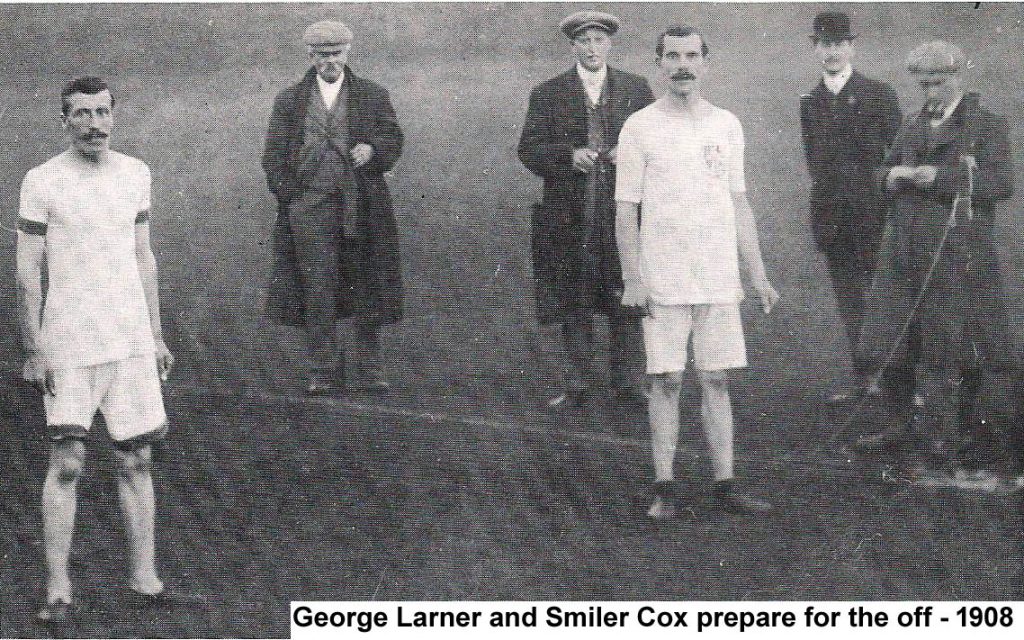
Thanks to Bob Cairns’s publication of Postcards of Old Lewes we have sight of a Runners vs. Walkers event in 1908.
The Brighton & County Harriers hosted a major athletics event at Lewes on 3rd September 1908 between Brighton Policeman, George Larner, the world’s walking champion and club mate Mr J.G.Cox who was a Lewes resident and a well-known talented cross-country runner.
The day had been spoilt when a heavy thundershower broke over the ground which affected the attendance but the main event of the day was well worth seeing.
Larner was to walk three miles while his opponent ran four.
A newspaper at the time reported, “When the two competitors appeared on the track there was a loud outburst of cheering. Both men were very fit and the men were watched with breathless interest.
“Larner’s walking was excellent and Cox ran well, keeping up a good pace throughout. As lap after lap was passed by the competitors, the spectators' excitement grew and they enthusiastically applauded urging them to yet greater efforts. Although the runner's pace was a fine one, he was unable to beat his antagonist and the famous pedestrian policeman won by 295 yards."
Larner’s time was 20 mins 47 seconds. Cox completed his four miles in 21 minutes 42 seconds.
In 1908 Larner was at the peak of his career. He had a string of English, British and World records to his name and, it was less than two months since he had won both Walking Gold medals at the London 1908 Olympic Games.
J.G.Cox was known as “smiler”, which was a fitting description, and I met him many times after WWII when he was one of the leading Sussex timekeepers.
Cairns was a more than useful middle-distance runner; when at Newhaven Secondary School in the same year as Bill Mullett, Roger Weedon and Sam Lambourne. He had several very good runs in Boys (U15) and Youths (U17) Road Relays but his best run was probably his Brighton & Hove team gold medal with Mullett, Stephenson and John Hazelden in the Southern Junior (U20) cross country championship in 1967.
Lewes A.C had been considering, albeit it tentatively, of restaging a Runner versus Walker event, they did it in 1999 while waiting for the track to be completed, before our Covid-19 and our current problems put it on the back burner. Who knows such an event may be a way of getting things going again when our troubles are over?
Could it provide a boost to Peter Selby and efforts to increase race walking in Sussex?
Next week Who is the Sussex Cross Country Runner?