
 With thanks to Crawley’s Dave Beattie for much information.
This week we look at how well Sussex runners have fared in the London to Brighton Run which is a youngster when compared with the walk as the first organised amateur race was not held until 1951.
Like the walk there were unofficial races and challenges but my search started with the first Official race held under A.A.A. Laws and organised by Ernest Neville, who was, and continued to be for many years heavily involved with both races. From this first race sprang the Road Running Club and it was virtually a race for the members.
For much of its life it did not cover the traditional A23 road but used the old London to Brighton Road and avoided much of the A23 traffic. It did not join the A23 until, more or less, the final One mile.
The London to Brighton Run, along with the Comrades Marathon in South Africa were certainly considered the top Long distances Running Races in the World and many South African runners would appear on the podium at the end of London to Brighton races.
Looking through the limited results that are available Sussex runners did not make much of an impression until the late seventies and 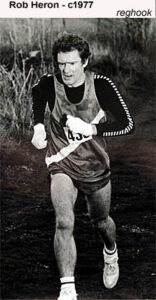 certainly did not get amongst the medals although Crawley’s Peter Bennett did finish ninth in 6:17:48s in 1965 and improved his time in 1966 to 6:08:17 but slipped to 12th in 1966. He returned again in 1970 but he was no quicker.
Rob Heron, from Aberdeen, who moved to Sussex in the seventies as Head Librarian of Bognor Teachers Training College and ran a couple of times for Bognor before joining Brighton & Hove, finished runner up in 1977 in 5:19:47. Two years later he took the bronze medal in 5:47:05 and now qualified as a Sussex athlete this was the fastest time in this race by a Sussex runner. Heron was a member of the first Sussex team, Brighton & Hove to win the Southern senior Cross Country championship in 1976.
South African athletes were banned from running in this event from 1975 as they were, from many sports around the World, because of apartheid so 1986 was a little confusing as Brighton & Hove’s Terry Tullett was the second runner to finish on the day in 5:53:10s but two months later the winner was revealed to be South African and was disqualified to make Tullett the first ever Sussex winner of the title.
The 1986 race was an important race for two other reasons as the Crawley team of Dave Beattie, Charlie Malsbury and Tony Lynch not only became the first Sussex team to win the team race, the Brighton & Hove squad took second team spot, it was the first of a remarkable run of twelve team victories and they were to repeat this victory for the next four years. This was later recognised by the 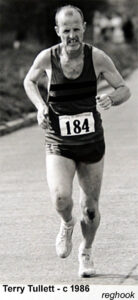 Road Runners Club that when it was decided to discontinue the race. It was decided the valuable “Len Hurst” championship that was awarded annually to the winning team that the Belt be awarded to the club that had won most times and that club was Crawley. It was also Dave Beattie’s first time inside the Top Ten placings. He finished ninth, to lead the team home and he was to complete no less than twenty L to B runs finishing in the Top Ten places six times and winning in 1990.
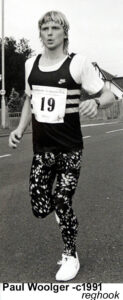
He repeated his ninth place in in 1988 with Charlie Malsbury having his best run in the L to B in seventh place while in 1989 was to finish ninth and club mate Paul Woolger showing what was to come by finishing 12th .
1990 was to be the big year for Dave as he became only the second Sussex runner to win the title, clocking his fastest time on the road in 5:54:32s to become the third Sussex runner to actually crack six hours for the course.
Sam Lambourne (Brighton & Hove), probably the king of long distance running in Sussex had an excellent run, just missing the medals in fourth place in 6:14:15s one place ahead of Woolger who showed further promise by finishing fifth in 6:14:51s and Tracey Harris (Brighton & Hove) made an impressive debut in 11th place.
Crawley won another team title with Brighton & Hove second team spot.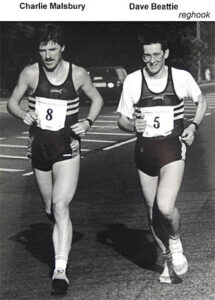
Woolger was to lead the Sussex runners home in 1991 taking the bronze medal with Terry Tullett was to finish 5th and Brighton & Hove club mate Tom Fallon had an excellent run in ninth place and Crawley took second team spot.
In 1992 There was another fifth placing for Paul Woolger and after missing a year another team victory for Crawley but it was three years before there was another Top Ten Sussex placing with Wally Hill (Crawley) finishing tenth in 1995 and Crawley taking third place in the team race in while in 1996 Wally was up to fifth place while Dave Beattie was back again with his fourth ninth placing and silver medal position for the team.
There was another team victory for Crawley in 1997 which was led home by Wally in seventh place and a gap of one year before another team victory in 1999 with Wally in fifth place and Dave Beattie in sixth position.
At the start of this Century Crawley were still in dominating form to take another team title, in 2000 with Wally leading them home in seventh place but there was new face to lead the Crawley and Sussex runners in 2001 when Brian Hennessey finished third in his debut run, another debutant, Viestus Dude placed fifth and Crawley had to settle for another second team spot.
 Hennessey was to record his first of three consecutive victories in 2002 the only Sussex athlete to win the title more than once. He just failed to crack the six hours for the course finishing adrift by just 58 seconds after 55 miles on the road with Wally Hill filling sixth place. Crawley again won the team title with Brighton & Hove in third place.
Because of the traffic in Brighton the finish was switched to Preston Park as the runners were getting to the finish before the timekeepers.
In 2003 he clocked 6:24:04s his second victory, with Brighton & Hove’s Simon Russell in seventh place in 7:03:40s and in 2004 Brian won in 6:13:59s with Dude taking fourth place while Brian clocked 6:08:31s in 2005 Brian was pushed into second place by a South African as they had been allowed back into the race. Five runs, three golds, one silver and one bronze is a remarkable record. Dave Beattie finished 25th for his 20th L to B a feat that has only ever been achieved by five other runners.
In the Age Groups Peter Lawrence was the first M40 to finish in both 1981 and 1983 clocking a Sussex best ti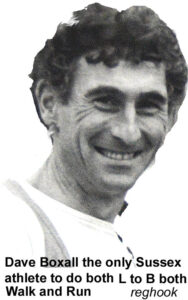 me of 5:37:16s and 5:52:36s respectively. In 1981 he was with the leading group and looked in line for the title as they entered Brighton and just missed a medal.
Dave Beattie was the first M40 runner to finish in 1990 the same year as he won his title and Wally Hill in 1996 in 6:39:55s and 1997 in 6:42:23s and the M45 title was won by Brighton & Hove’s Sam Lambourne in 1993 in 6:49:53s.
and the M50 by Dave Beattie in 1997 in 6:58:46s while Dave Boxall (Brighton & Hove) is the only Sussex runner to compete in the L to B Walk, where he won three bronze medals and a gold in the team race, appeared three times in the run with a best placing of 30th in 1992 won the M55 in that year.
The final run was held in 2005.