
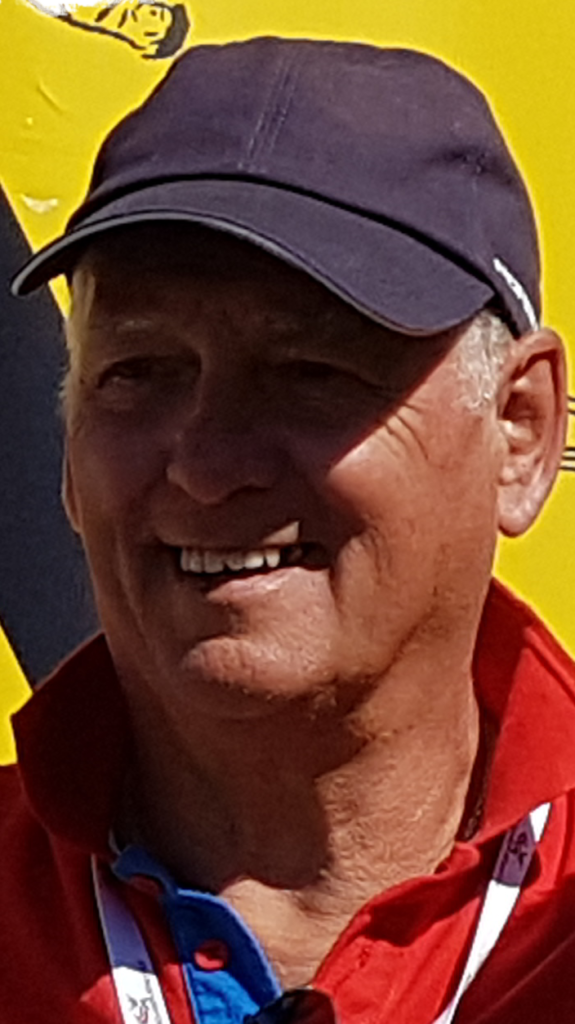
Despite ongoing issues with facilities, Worthing’s Eric Davison has managed to coach a string of top level throwers over the years. He says watching his athletes develop into confident, happy adults is as much a part of his role as coaching the sport. Kate Matthews caught up with Eric for a chat about coaching and how his group are coping with Covid19.
Kate: Who are you?
Eric: My name is Eric Davison, I am 67 years old and a Worthing & District Harriers hammer and discus coach.
Kate: Which athletes do you and have you coached?
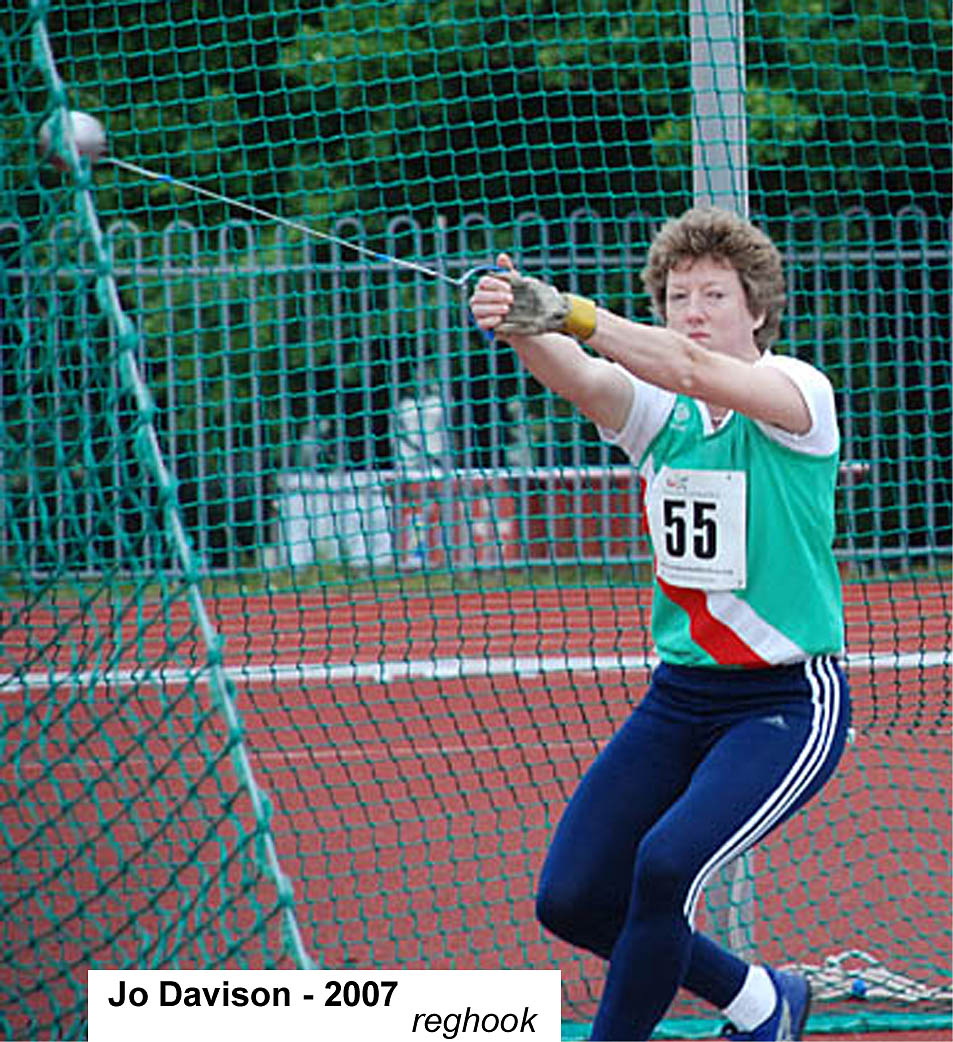 Eric: I have been very fortunate to have coached lots of good athletes over the years and did have a squad of 21 athletes of all ages and abilities. These included Joanne Davison, hammer thrower, who won a gold medal in Melbourne in 2005 in the Deaflympics (I was not coaching her at the time). I started coaching her about a year after, she went onto win bronze at the 2008 World Deaf Championships in Izmir, Turkey and also bronze in 2009 Deaflympics in Taipei. She still holds the hearing UK Masters records for her age group to this day with W40 age 44 – PB 50.11m Izmir TUR 24.9.2008 and W45 age 45 - PB50.13 Swindon 30.5.2009.
Within the squad there have been many county champions, intercounty champions, SEAA champions. The squad also had a good representation at the ESAA with Woody Cox taking gold in the 2011 U15 hammer followed by gold at the SEAA U15/U20 Inter-counties Championship with a throw of PB55.99m. Next was U17 Ben Hawkes taking gold in the hammer in 2017 and also gold at the SIAB International with a bronze in 2018 as a U20.
As an U17 Ben won gold at England Athletics U15/U17 Championship, gold at the South of England AA U15/U17 Championships and gold at the Sussex Schools Championship with all throws over 70m. Ben finished number 1 in the UK that year with a best of 71.97m. As an U20 Ben carried on to take gold at the South of England AA U20 / Senior Championships and in 2019 his good form continued with 1st in the Loughborough International, 1st in the Loughborough Winter Throws Open, 1st in the South of England AA U20/Senior Championships, 1st England Athletics U20/U23 Championships with 73.15m. An incredible session with a 2nd Place in Mannheim Germany Bauhaus Junior Gala Invitation and 7th place in the European Athletics U20 Championships just missing out on the final.
Unfortunately due to work commitments I had to step away from the large squad I was coaching a few years ago and reduce my coaching  involvement but continued with Ben, Sam Illsley and Freya Brennand. A couple of years ago Worthing Harriers lost the use of their throws cage, which has made training a nightmare. We were traveling to Horsham to throw (they too have now lost the use of their cage which has been taken down). This only left us Portsmouth Mount Batten Centre which we travel to for throws sessions. At Worthing we cannot entice new throwers to the club as we cannot throw there until we can get a new cage.
However, since I have been coaching down at Portsmouth, I was invited to coach there on Saturdays with the SETAFA guys (South of England Track and Field Academy) and help with any athletes that would like to throw hammer or discus. This has led to the group getting bigger as I have been involved with helping two coaches and three athletes from Winchester and a coach and athlete from Chichester. There is an athlete that travels from Southampton who works with Bron Carter for shot put and she asked me to look after him for Hammer. Bron has brought me several athletes that wanted to be part of the throws group.
Kate: How long have you been coaching and how did you get into it?
Eric: In 2004 I started to get involved with coaching as my wife was competing at the time and I was working with her coach who said I should get into coaching as I had a good technical understanding of the event. So, in 2005 I started my coaching pathway and now have 16 years of coaching behind me.
Kate: Were you an athlete before a coach, and if so, what distances/disciplines? How does coaching compare to the thrill of being an athlete yourself?
Eric: My sport was and still is badminton, and at the time .22 target shooting, I am also a solo glider pilot. I have now moved to clay shooting these days. Each having their own version of thrills. Coaching is a completely different thrill to taking part in an event. As a coach  you are not just there for the athlete to learn the skills for the events they are training for. You quickly learn you are looked up to for advice and guidance by parents, coaches and athletes on every subject there is. The thrill for me is to see the athletes enjoy themselves in their events and attain new PBs and progress with their development, not just in athletics but in life. To see them develop into fine young adults and knowing you had a hand in that makes it all worthwhile.
Kate: How often do you coach? Types of sessions etc?
Eric: This varies these days as the amount of athletes I work with is small but about 3 sessions. Ben was working from a training plan I gave him but was very interested in doing his own training plans and because of the time he had available to him he would do several weight and strength and conditioning sessions at different times during the week. We would do our Saturday throws session and fit in another throws’ session during the day in the week. Since Ben is now at Cardiff University, he is working with the throws coach there. His training plans are now sorted out by one of their team. Sam had a training plan I gave him and again he would work of this one and change it where he wanted to, but again train at different times during the week. He would join us on the Saturday throws session and on the Monday nights we would go to Horsham where we did throws (when we could) and a weights session. Freya has been learning Olympic lifts with me and has been doing Strength & Conditioning work at Worthing College as she has the use of the gym for free. Working around Freya’s college work and free time we were throwing on Saturdays and weights on a Tuesday evening, Thursday drills if we could at the Worthing Sports centre.
Kate: What are the highs and lows of being a coach?
Eric: When you see an athlete that has been training so hard to attain their goals and then achieve them in a competition, is a great feeling and I am so happy for them you cannot really describe it. I am gutted if an athlete has a nightmare on the day of a big comp. I feel as sick as they do but you cannot show it as you have to be positive for them. You are not just their coach, you are their friend, someone they can come to talk to you about anything. So, you are there for whatever comes your way. One of the lows for me is the position I am in with having to travel a long way to throw. If you live in Worthing it would be nice to compete and train in Worthing rather than running around the  countryside trying to find a place to train. Parents do have to work and cannot always get their athlete to the training ground and then we are asking them to travel to Portsmouth. I am always aware that parents have other commitments and cannot just drop everything to take one of their children 40 miles for a session. We have been lucky in the past that Ben and Sam have cars and shared the traveling.
Kate: What is/are your proudest moment(s)?
Eric: There are many. When you work with young athletes developing their skills, confidence, some are shy and you see them grow into confident young boys and girls. That is a proud moment knowing you had a hand in that. Sports moments are all of the above plus, the way the squad behaved and conducted themselves within competition and training. They have all given me magic moments.
Kate: What have been the hardest moments?
Eric: The frustration of not being able to train properly. When the emphasis is on where we are going to train and how, rather than the session ahead.
Kate: How do you motivate your athletes to keep going and focus?
Eric: With the large squad there was always good banter amongst them, so the level of the good feel factor was high. The need to motivate was really not a problem then and it is not now either. Anyone having problems I would take aside and talk about it with them. With reassurance and positive thoughts going forward usually did the trick. On the occasions this arose was when someone had a bad comp. At a competition I would always talk to each one separately before the competition started, talk about how they were feeling and depending on the answers I may suggest certain things, or give them a tap on the back and tell them to go and enjoy yourself you have trained hard enough now go and have fun. Also talking to them after their competition. If they have done well it was easier to do as you can talk about what went well, what we can work on, how best can we prepare for the next one. If the competition did not go well for them, the approach would be different, this is where knowing your athletes is important as if you do know them well, you will know the best time to talk to them and how you will talk to them and support them.
Kate: What has coaching athletics brought to your life?
Eric: So many wonderful memories as you can see above. I have learnt how to talk to youngsters, understand them and their language (sometimes) and what makes each one of the athletes’ tick, that is very important to know the athlete you are helping. Learn how to get a point across and get the best out of them - this can be a very challenging one as you try and find the trigger word that makes them click. I have met many great parents, formed memorable friendships with them and the athletes. Also met some great coach characters and had many good banter conversations.
Kate: Has coaching changed over the years?
Eric: Yes it has. New ways of looking at coaching and the way the coaches work. Some new thoughts you may not agree with, but you take what you need out of it and use it, you can never know enough. The big thing is how much you are expected to know. There are now many courses which is good if you have the time. It can be very time consuming when most of us have to work and another life as well.
Kate: What are the main difficulties that face you and your athletes in normal times?
Eric: At this time it’s the lack of a hammer and discus cage/facilities at Worthing District Harriers.
Kate: What have been the main difficulties facing you and your athletes during Covid19? How have you overcome these? Is it getting harder to manage the more lockdowns we face?
Eric: Not being able to train has been the biggest factor. Being on national lockdown just closed all doors for us. Freya has got some form of gym equipment at home which has allowed her to keep up her physical training. She is doing the best she can with some exercises and fitness work to keep her going. Worthing College of which Freya is attending, are running some strength & conditioning classes online which is proving useful. As to technical drills, Freya’s has nowhere she can do these so like a lot of athletes she is losing out in this area. This has a big impact on their training plans/planning for competitions and the goals that have been set for this season, which will also impact their goals for next year too. How can you plan for an event that you don’t know if it’s going to happen because you don’t know when restrictions will be lifted? When can we get into sports centres to use their facilities?
Kate: Would you encourage others to become coaches and why?
Eric: Yes I would, the rewards are well worth the effort, as you can see from my previous comments. What you would need to do is consider how much time you can spare a week and whether you are able to be free to coach and support athletes and the club at events at the weekends as this is also a big part of it. As a level 1 coach you can assist an athletics’ coach. You can then work and see how working with coaches and athletes work, then you can decide if this is maybe as far as you want to go or to get involved more.
Kate: How could the world of athletics be improved for both athletes and coaches?
Eric: This for me is an interesting question. A lot of hard work, time/traveling goes into coaching. Most of us start the coaching pathway as club coaches and do so for many years. If you are fortunate to have athletes that perform to an international standard, this is where there is a gap between the club coach and the next level. There is support leading up to this point but there is not a clear pathway to the next level. To have an opportunity to work with coaches who have this experience and travel to international venues would get a better understanding of what happens together with seeing other international coaches working is a great way to learn. There should also be some financial help to make this happen. A change of attitude and support here would defiantly help with the development of the club coach and his/her support of the athletes he/she has moving into this new area of international athletics.