
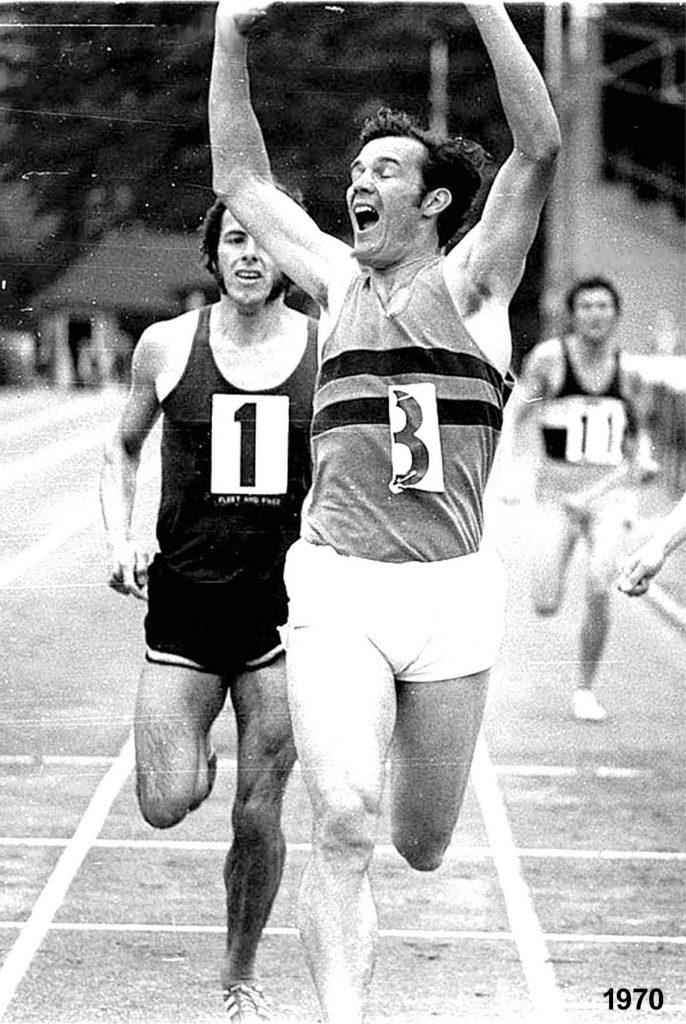
Chris Carter is rather unusual amongst Sussex athletes as he is a top class international, dual Olympian athlete who remained in the sport as an administrator following his retirement from active competition. Only Olympian Ernie Henley, another 800/400 metres runner from 1910 to 1950s, and international sprinter Dick Webb would stand alongside him in this matter in Sussex.
He also is the first of these historical portraits to still be with us.
Chris was born at Steyning to Sid and Mary Carter on Christmas Day 1942 and attended Steyning Grammar School where his ability as a middle distance runner was noted by P.E. teacher Bob Webster and tackled the East Monday Road walks and joined Steyning Athletic Club for a short time before moving on to the Hove Athletic club which was soon to merge and become the Brighton & Hove Athletic Club.
 A powerful fast finishing runner Chis also tackled many cross-country events.
It was in 1959 when he won his first Sussex County title. He won the Youth’s 880y in 2:02.1s and in the same year he took the bronze medal in the England Schools Inter 880y in 2:00.5s having broken the two minute barrier in his heat for the first time despite being beaten into second place in the Sussex Schools championships a month before.
The following year, after another second place in the Sussex Schools senior 880y he was still the first Sussex runner at the English Schools placing fifth.
This was his final appearance at the English Schools because, after being rejected for Aircrew for the R.A.F he joined the Brighton County Borough Police as a police cadet.
His career also marked the end of the really top amateur athletes who had to hold down a full time job and fit in his training and racing in his own time although the police, knowing they had a gem in their force, were helpful particularly with his eventual international racing.
Even at the top of his form, unlike today’s middle distance runners, continued to race in club, County, Area, Inter-county and National races and it was nothing to race in a dozen or more major races in a season at County level or higher as well as slipping in a couple of Cross-country events.
1963 saw a major breakthrough racing in no less than 10 major events including his first National Police title and five international events finishing second against the Russians in Volgograd and winning with a personal best of 1:48.7 against Hungary in Budapest.
There were thirteen major races in 1964, starting with the Sussex Championships and five international event culminating with victories and pbs over 800 metres against both Poland and France at the white City, which probably confirmed him a place in the British team for the Tokyo Olympics.
In what was the most successful Olympics for Britain since 1908 Chris finished fourth in the semi-final of the 800m which gave him a place in the relay in the Commonwealth Games team to meet U.S.A in Osaka a few days later. 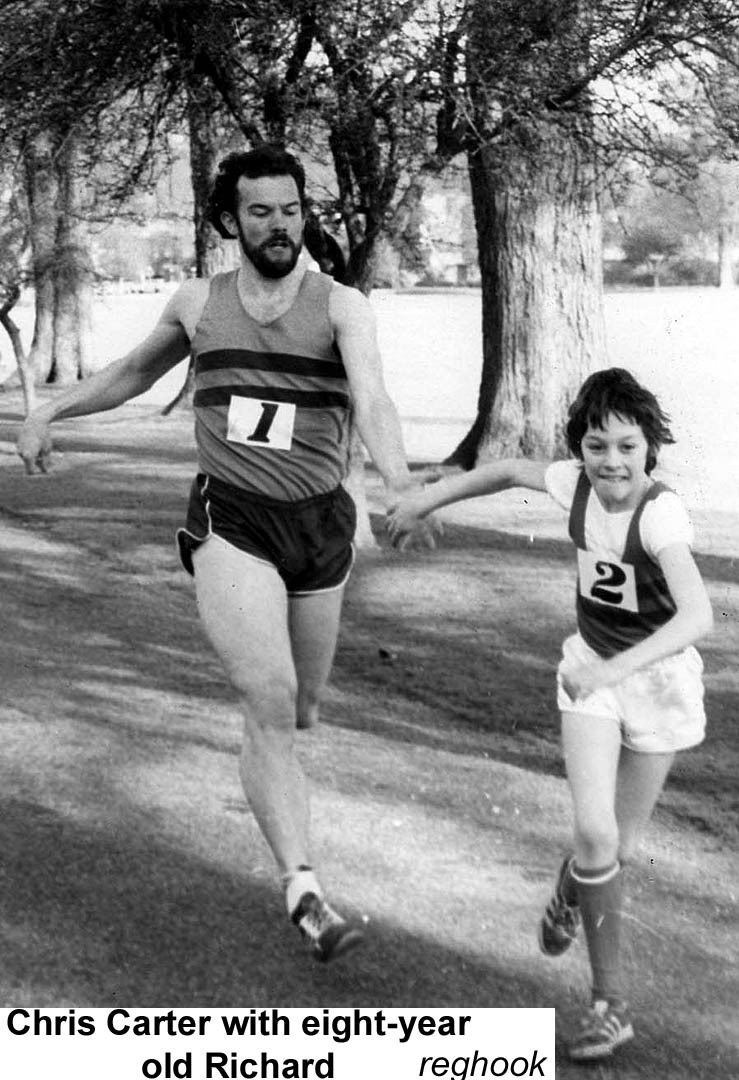
In 1964 Chris also managed to find time to marry Elaine Bleach who had been his girl-friend since they met when she was 14 while they were both at School at Steyning.
Another 13 major races in 1965 starting with the Sussex Cross-country championships and his first C.A.U 880y victory at White City. It must be remembered that back in the sixties the Inter-county meeting at Whitsun was only second of importance to the A.A.As championships on the domestic calendar and all the leading British athletes would be in action.
In the match against East Germany Chris equalled the British record with 1:46.6s and that was also the second fastest time in the world for 1965.
It was a particularly busy year in 1966 with Cross-country races at the beginning and the end of the twenty two race year. He competed in both the Commonwealth Games in Kingston Jamaica, where he finished fifth in 1:48.1 and the European Champs at Budapest where he had probably his best ever run. He led for most of the race and was still leading into the home straight when he was overhauled and finished a fine fourth in a new British record time of 1:46.3s before returning home for more international events.
He also clocked his fastet Mile time when he finished 4th, behind Alan Simpson when he ran what is still (2020) the only “Four minute-mile to be run in Sussex, at Withdean.
There was little let up in the pre-Olympic year,1967, an international trip to South Africa early in the year and another C.A.U 880y victory at Whitsun and more trips to Berlin and Los Angeles later in the season but one eye was steadily on making the British team to the Mexico Olympics in 1968.
Another C.A.U 880y victory but this time in a new European, British All Comers, English Native, White City and Inter-county record of 1:47.2s suggested he was in good form but he still managed to fit in a 440/880y double at the County Championships and some fine international results with an eye on gaining selection to race for Great Britain in the Olympics at Mexico City. His form suggested he was at least a potential finalist at Mexico though there was always a question mark how the altitude would trouble the athletes.
However a pre- Olympic 400m in 48.3s set off a foot injury that was to sabotage his Olympics. His foot did not hold out in the first round of the 800m and he dipped out in sixth in 1:52.1 and this was his last race for over a year.
1968 was a particularly good Olympics for Sussex with Brighton & Hove club mates Arthur Jones selected (30km Walk) and 400m hurdler Andy Todd (Relay), which was more athletes than any other club selected for the team plus Worthing’s Pat Jones (High hurdles) also in the team.
Chris was determined to continue with his athletics and successfully defended his European Police title in 1970 and made appearances for his club in Division One of the British League.
He said “I worked hard during the 1970/71 winter with a 1200m time of 3.00.9 at the Crystal Palace in December. Many cross country races for the Police and club teams. Summer season was to be a hard season with the ultimate aim to make the 1972 British Olympic team Won the County Championship 800m in 1.53.6 but had to take second in the 400m in 49.8 behind Dave Scharer (48.8). Best 800m was a time of 1.49.2 in 4th place at the AAA Championships at the Crystal Palace. Best 400m time was 49.3. My last International race was to compete for GB at relays meeting in Paris where as part of a 4 x 800m relay team I ran a 1.52.0 leg.”
“In March 1972 the family moved to Chichester on my promotion to Police Sergeant continued to train both at Chichester and Brighton. In May I went as a guest with the Sussex University team to Barcelona and sustained a leg injury. This proved troublesome although in June I won the County Championship 400m and 800m in 49.9 and 1.55.5. Although I ran a seasons best of 1.52.0 in the heat of the AAA Championship 800m I did not make the final.
I decided to run more for fun and the Athletic Club. In 1973 I ran mostly 400m and relays with a best of 51.0 although I did manage a 1.55.9 for third in National League match in Sale”
In 1973 Chris won a place at Sussex University to read Sociology and without any definite goals continued to train quite well.
 He ran more 800m races in 1974, including winning the County title again and defended his European Police title in Berlin where he finished fifth in 1:52.7s but most of his races were club or British League events he continued to train and managed to run a leg in the Club’s 100 X one mile clocking 5:01.8s before handing over to eight year old son Richard who clocked 6:28.
Coaching took up more of his time as he took on a group of promising young club athletes as well as Richard most of them going to England Schools and Simon Morley was to win the senior 800m title while Richard eventually won the English Schools senior 5000m title twice and also went on to win Inter-County and National junior cross-country titles.
In 1980 he became a member of the Southern Counties A.A.A and thus started another aspect of Chris Carter the athletics administrator. He also became the Brighton & Hove Athletic Club chairman, a post he held until 2012.
He served on several Southern Committees as well as representing them on the A.A.A General committee and the newly formed British Athletics Federation (BAF) General Committee.
In 1993 he took on the role of Out of Competition Drug Testing Co-ordinator for BAF and was also elected Secretary of the BAF Track and Feld Commission and as such became one of the team selectors for British international teams, both senior and junior for World, European and Olympic Games.
In 1998 Chris was elected Secretary of the South of England, a role he held for 16 years
With the reorganisation of the sport of Athletics in 2004 he became a member of the Management Board of the AAA of England which had a smaller role in the administration of athletics in England as much was given to the newly formed England Athletics. He was asked to chair the England selectors for the 2006 Commonwealth Games in Melbourne and travelled to Melbourne as Head of the Athletics delegation.
Chris said “I had decided to step back from many of the roles I had taken on in athletics when reaching seventy. Unfortunately this was slightly forced upon me when I had a stroke in 2012. I retired from being Chairman of the Athletic Club, retired from the South of England roles in 2014 and having been Chairman of the AAA of England since 2009 retired from that role in 2017. I could probably have continued in this role for a few more years but Elaine became seriously ill and I retired from all roles within the sport in 2017”.
“My years within the sport as competitor, coach and administrator were made easier by the attitude to the sport by my bosses in the Sussex Police (1961-1991), where I rose to Inspector, and Elaine, my wife who also loved the sport and the travel opportunity it gave to us both in Britain and abroad. It is also an individual sport but one that you can make friends from all walks of life who remain friends. It has also given me the opportunity to meet and talk to many people not connected to the sport but have an interest in sport and life in general”
Chris made nearly seventy years of service to athletics as an athlete and administrator and few National figures can match that though High jumper Arthur Gold, All-rounder Sandy Duncan, who also had strong Sussex connections and Olympic sprint champion Harold Abrahams have made major contributions and latterly Seb Coe has been chalking up the years but he had a few years to go to match the contribution that other have made.