
MICK JONES by Tony Miller
One of the most enjoyable moments of my 50+ years in athletics was being in the commentary box and witnessing Mick Jones on the greatest day of his sporting life, winning the 2002 Commonwealth title in Manchester.
I did get reprimanded for standing up and cheering but I put that down to their ignorance. They had no appreciation that something special had just happened.
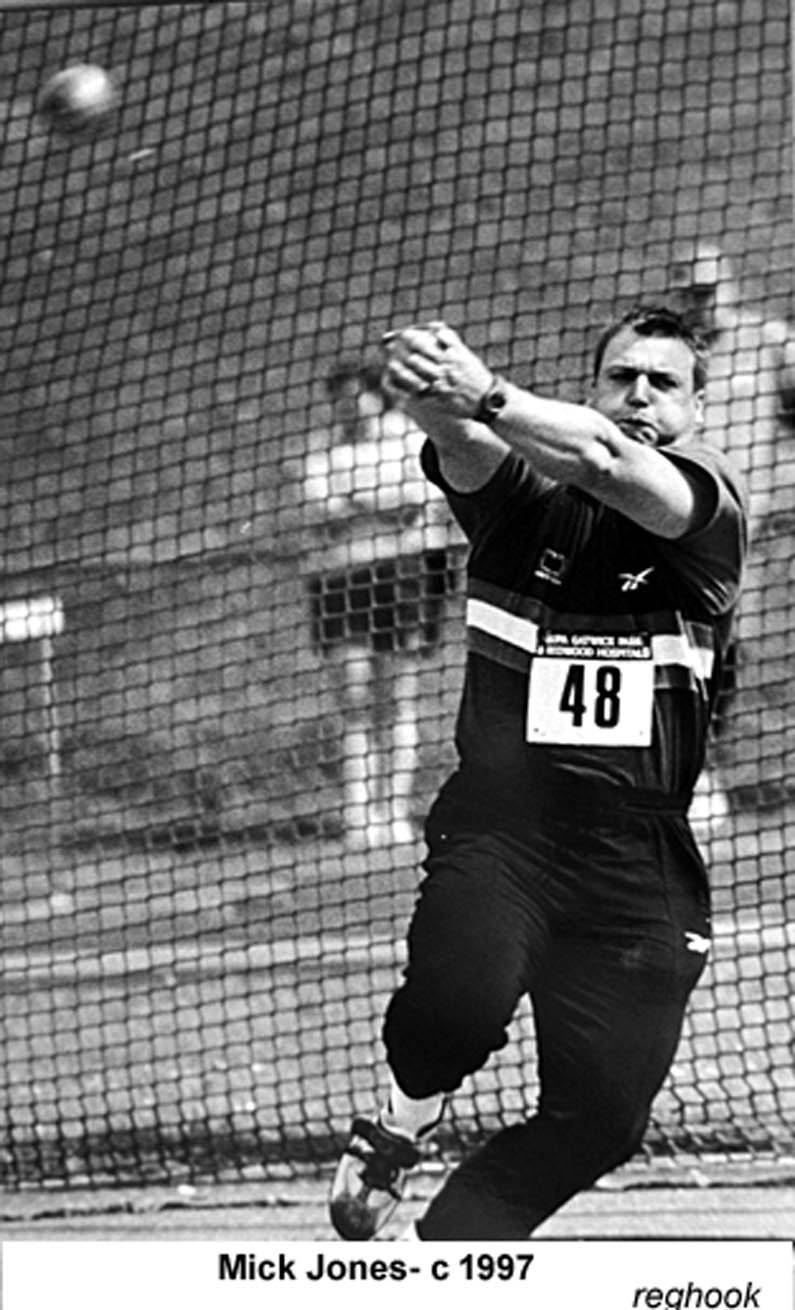 If longevity and sheer consistency were the determining factors, Michael David Jones could lay claim to being the greatest UK hammer thrower ever. His number of competitions (126) and years (20) over 70 metres put him way above everyone else.
Mick was in the UK top 10 rankings every year from 1982-2008 (that total of 27 years being a record for any event) – and was a consistent number one from 1998, when he won silver at the Commonwealth Games. Four years later he had his career highlight when the gentle giant won gold in Manchester.
Born in Chelsea in 1963, he started lifting weights at the age of 11 and did a lot of boxing at school – “My boxing coach in Crawley was also the hurdles coach at Crawley Athletics Club so I ended up down at the Club”. He first made an impact winning the Sussex Youths title in 1979 with a throw of 56.18 which placed him 4th on the UK lists for the year. He went on to finish 3rd in the English Schools.
12 months later, he had improved to 63.44 and up to 3rd in the UK lists. He stepped up an age group and was 3rd in the National U20 Championship throwing the senior 7.26k hammer rather than his usual 5k implement.
In 1981 he moved up to the junior age group but he was throwing the senior implement more often and won his first Sussex Senior title at 17. Two weeks later, he was 6th in the UK seniors, and on June 13th gained his first international vest in an U20 match versus Germany.
A year later, he was 3rd as an 18 year old at the 1982 UK seniors and won the Southern senior. He improved to 67.48 to top the UK junior lists and won the National junior title. The season ended with victory in the Junior international in Amsterdam.
In 1983, Mick moved from Crawley AC to Shaftesbury for better competition. Shaftesbury were in the British League Div 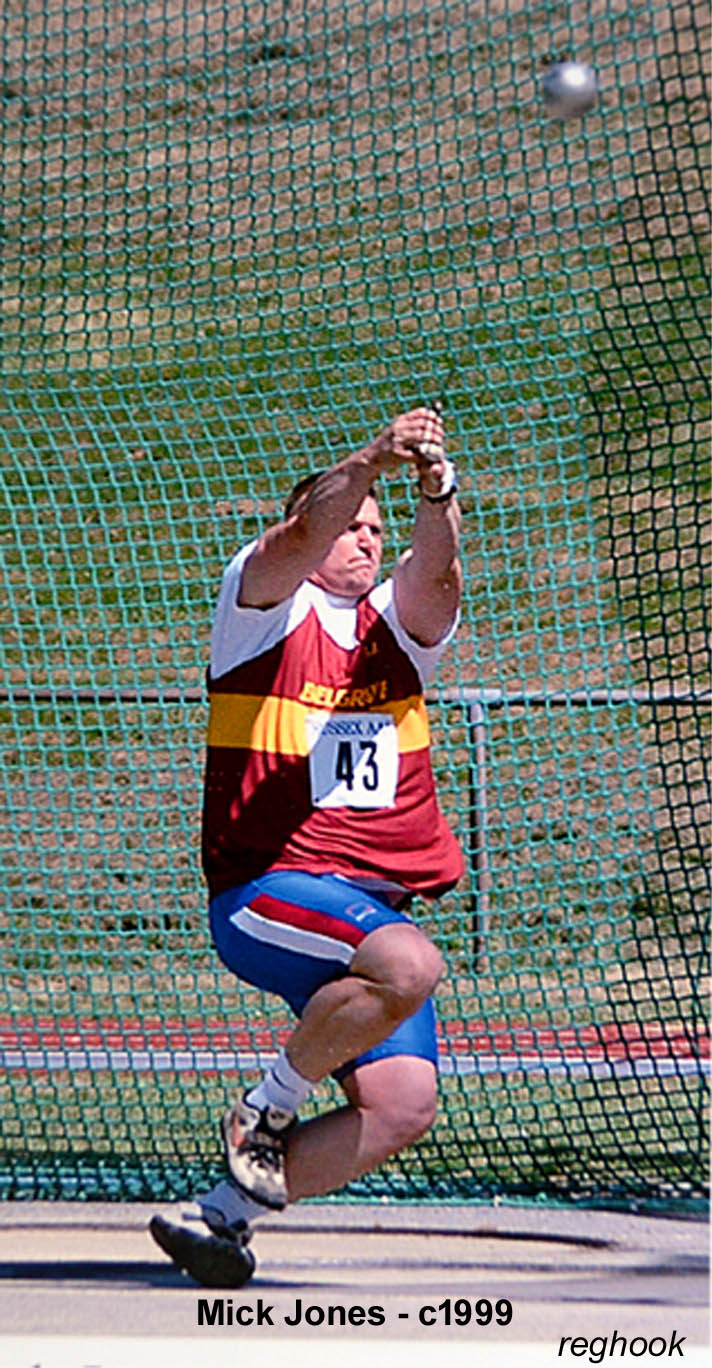 1 so he was regularly up against the top throwers. He retained his Southern title and won the Inter Counties for Sussex. His first senior international came the following year in a match against the former Yugoslavia.
He first achieved 70 metres at the 1986 Commonwealth Games (70.10), when he lost the bronze medal to Phil Spivey of Australia in the last round. Mick was also 4th in the 1994 Commonwealths (68.42). He has won three Inter-Counties and four Southern titles. He had the longest throw by a UK athlete at the 1988 Olympics with 70.38 but missed out on a place in the final. 1996 saw consistent form, with 71m throws at the European Cup final and AAA championships, and he beat his eight year old PB with 72.48. Though below this form in 1997 he returned to 70 metre standard at the end of the season.
1998 was an outstanding season, and signalled the start of an unbeaten 5 year run domestically. Early in the season he improved his pb to 72.55 for a fine second place in the European Clubs Cup final, and a few weeks later reached 73.28 to win a British League match. At age 35 he finally won the AAA title and at the end of August threw 73.47 to win the Gold Cup Final.
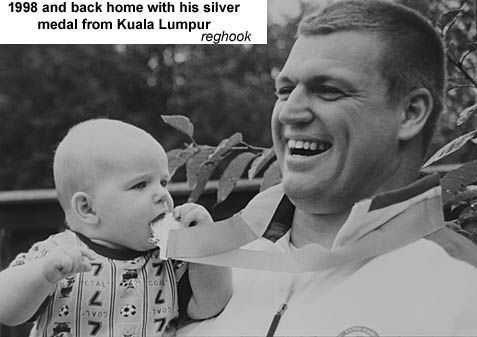
Internationally Mick threw well on important occasions in 1998 - 6th in the European Cup (72.28) and 5th in the World Cup (72.89). Above all he finally won a Commonwealth medal - winning silver in Kuala Lumpur with two more pbs: 73.51 and 74.02, for joint seventh on the UK all-time list. A magnificent performance after so many years as the nearly man of UK hammer throwing. At this time Mick was working as a warehouseman shifting baths and shower parts. He used his lunchtimes to train in a farmer’s field: Ockley Court Farm. After work, tea with his family was followed by more training and drills in a nearby car park. He did his first ever winter warm weather training at the age of 35 in South Africa and did some training with Hungarian throwers who had the opportunity to throw far more often each day.
Further improvement followed in 1999 and an early season 75.20 was the longest by a Briton for 13 years but tantalisingly short of the tough World Championship qualifier of 75.50
His standard continued to improve and in 2000 he exceeded the Olympic qualifying standard – but a week after the deadline. Determined not to miss out in 2001 he beat the World qualifying mark in a British League match, and had a remarkable series of throws: 76.43, 75.85, 75.64, 73.42, 75.66, 74.98. At this time he had no sponsor and his trainers had been bought at a car boot sale! He threw 73m at both the European Cup and the World Championships. From autumn 2001 he started work as a sports massage therapist and left the furniture warehouse job he’d been in for nearly ten years. He qualified as a masseur at St Mary’s Twickenham and based himself at Crawley. This gave him more time to train.
Mick was by no means favourite for the 2002 Commonwealth title – that honour was with Australian Stuart Rendall, who had a nightmare competition of poor throws inside the sector and long throws well wide of the sector. Mick won with just over 70m but improved to 72.55 in the final round, sharing the golden limelight that evening with Paula Radcliffe and Jonathan Edwards. It was a golden few days also for Alan Bertram (his coach since 1977) as another of his pupils Lorraine Shaw had earlier won the women’s event.
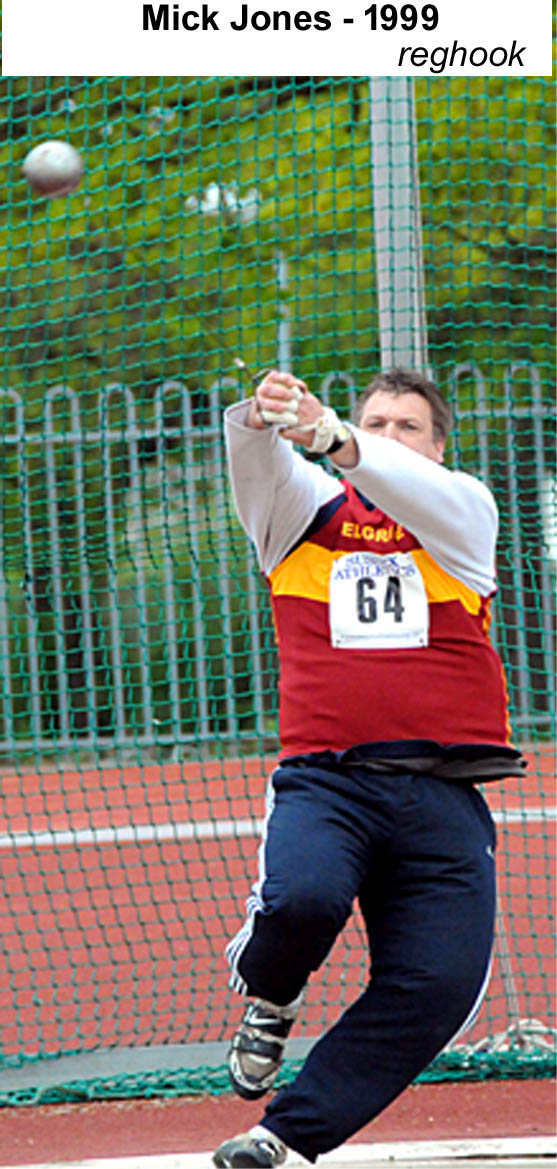 The next evening Mick received his gold medal and had to choke back the tears as 38,000 sang the anthem in his honour. Then at 2am he jumped in his car as he had to get back to work that afternoon. The gold medal brought no fame and fortune though. In fact, his Lottery funding (albeit minimal) was stopped and he had to juggle 5 jobs that winter in order to make ends meet.
Mick made his fifth Commonwealth Games in Melbourne 2006 but 70.09 was enough for just 5th place this time. For the next few years he turned in only the County Championships and BAL matches, and effectively retired at the end of 2010, a year in which he set a new World M45 record of 70.36.
He remarkably returned in 2017 to win the Sussex title again at the age of 53 and then won the British Masters title with a UK M50 best of 70.37 with the 6k implement. He was national champion 6 times and a medallist on 15 occasions, a men’s record for any event.
In recent years he has turned to coaching, including two of his sons Lewis and Marcus and was the Scottish National Throws Coach for 8 years.
With acknowledgements to Ian Tempest and Peter Matthews